Blog Series: Interchange, Demystified
Part 1: What Are Interchange Fees? A Plain English Guide
What is interchange, in plain English?
Here’s how the Federal Reserve defines it:
“Any fee established, charged, or received by a payment card network and paid by a merchant or an acquirer for the purpose of compensating an issuer for its involvement in an electronic debit transaction.” (Regulation II)
I’m a lawyer by training, and even I had to read that twice. If your eyes glazed over, you’re in good company, and that’s why almost nobody talks about interchange. Stick with me. It gets more interesting.
In plain English: every time a customer pays you with a card, a small slice goes to the bank that issued it (think Chase, Bank of America, or Capital One). That slice is interchange. It never shows up as its own bill. It’s buried in your processing fees, on every tap, every card on file, and every invoice paid with a corporate card. For most companies that take cards, it’s one of the biggest costs on the books.
Where did it come from?
The first interchange fee is older than the World Wide Web. In 1971, the banks behind BankAmericard (the group that later became Visa) set one rate for everyone: the store’s bank paid the card’s bank 1.95%. That made sense when every sale was a carbon-paper slip with a name, a number, and a signature. There was nothing else to judge it by.
Once payments went electronic, the networks could tell transactions apart and price them differently. Today Visa and Mastercard publish hundreds of rates, from about 22 cents on many debit cards to more than 3% on some credit cards. (The debit number is in flux: on October 26, a federal appeals court struck down the Fed’s debit cap and sent it back to be rewritten. That’s a story for another post.)
Think of interchange as insurance you’re required to buy
Every card payment has a risk-taker: the card’s bank. On credit cards, it fronts the money and eats the loss if the cardholder never pays. On any card, it eats the fraud losses it can’t push back onto the merchant. Interchange is the premium for that risk.
If you’ve rented a car in Italy, you know the feeling: the insurance isn’t optional. It’s part of the price. And like any insurance, not everyone pays the same rate. A 45-year-old with a clean record pays less than a 22-year-old with three speeding tickets. Interchange works the same way: the safer a transaction looks to the bank, the lower the rate.
Two footnotes, because the analogy isn’t perfect:
- This insurance has a deductible. If a fraudulent online order turns into a chargeback, you often still eat the loss. Interchange covers the bank’s risk, not yours.
- The premiums pay for more than the claims. Card fraud is real, about $33 billion worldwide in 2024. But interchange also funds your customers’ rewards points and the banks’ profits. (Insurers like a profit too.)
Who gets paid?
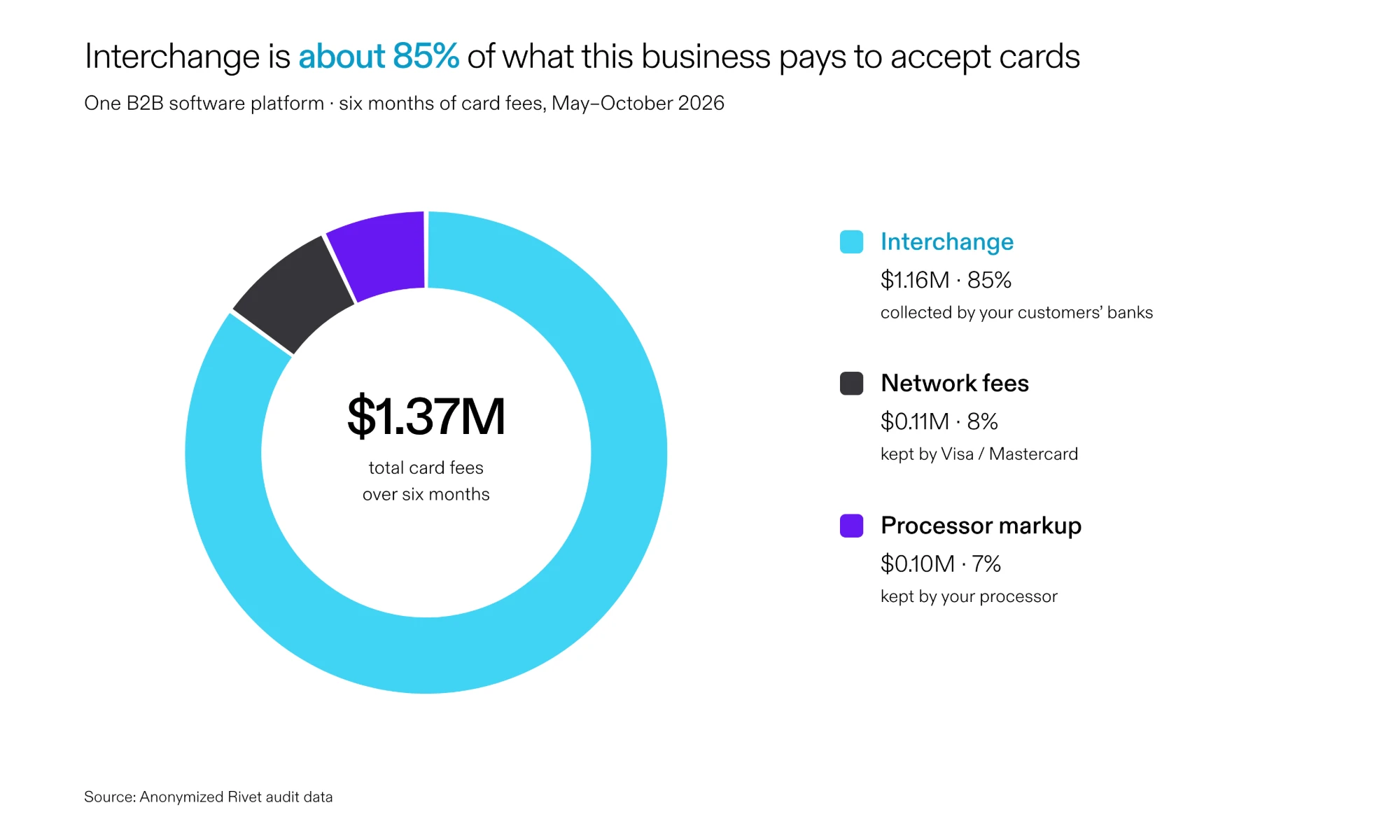
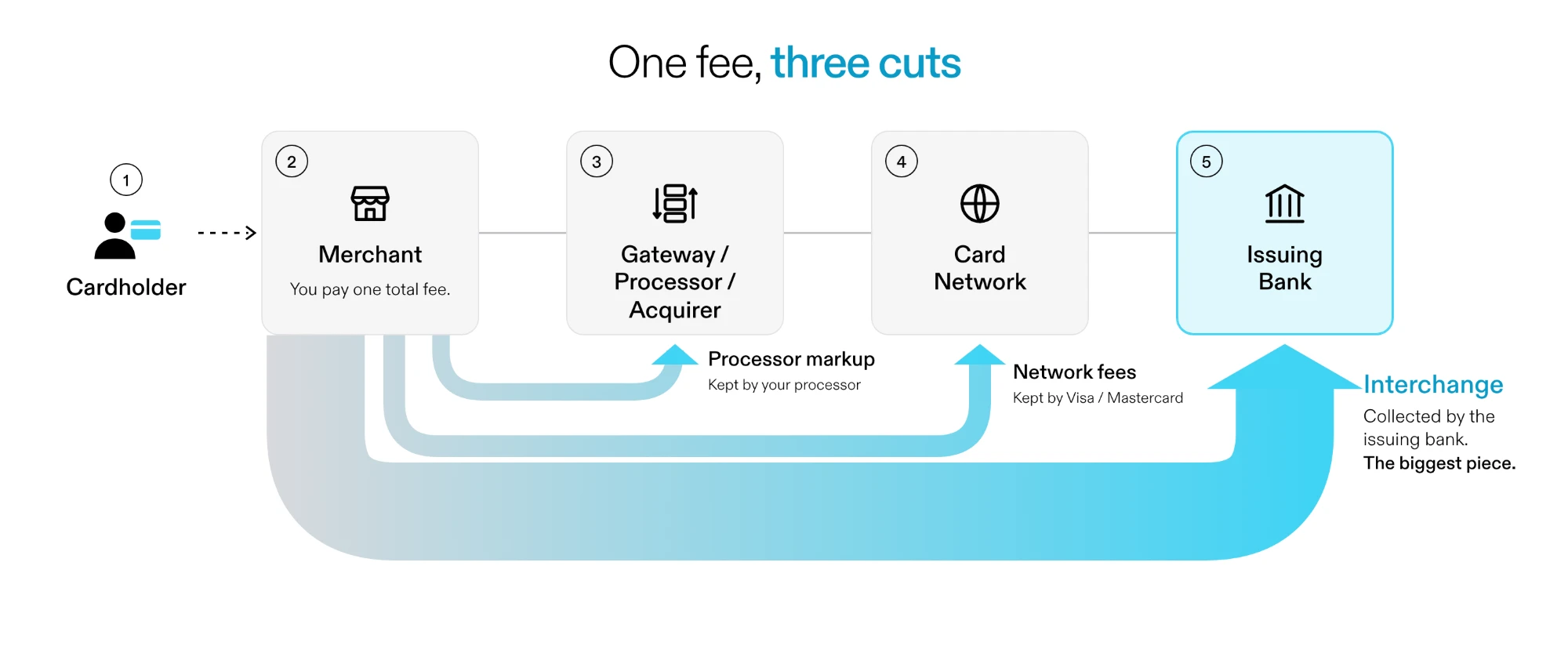
Your processing bill has three layers. Interchange goes to your customer’s bank, and it’s the big one. Network fees go to Visa or Mastercard, which also write the rules and set interchange rates. Processor markup is what your processor keeps.
So most of what you pay to accept cards goes not to the processor you talk to, but to your customers’ banks.
What decides your rate?
Put yourself in the issuing bank’s shoes. A $60 charge at a big-box store, card tapped at the register? Easy. A $4,000 charge typed into an online form, at a business that started taking cards last month, on a foreign card, with no billing address? Much harder to call.
Your rate comes down to a handful of levers:
- Debit vs. credit: debit is usually cheaper.
- In person vs. online: in person is cheaper, and a tapped or dipped card beats one typed in by hand.
- Basic vs. premium rewards card: basic is cheaper. (Those points come from somewhere.)
- Domestic vs. international: domestic is cheaper.
- Your industry: the networks run separate programs for categories like supermarkets, utilities, and healthcare.
- Complete vs. missing data: complete is cheaper.
Your customers and your business model set most of these. The last one is yours.
What does data have to do with it?
Every card payment carries a payload, the bundle of information that travels with it. Most people hear “data” and think of Level 2 and Level 3, the itemized details on business-card payments. Those matter. But the issuing bank is asking three questions, and line items answer only one:
- “Is this a normal, well-run payment?” Did you settle within about a day? Does the settled amount match what you authorized? For online orders, did you check the billing ZIP? Skip that, and a typical consumer credit card can jump from about 1.80% to 2.30%.
- “Is this really my cardholder?” Network tokens and authentication data (a device ID, IP address, and email shared with the issuer behind the scenes) help the bank trust the buyer. In one audit, 41% of a software platform’s $606 million in volume qualified for a better rate, mostly because of missing tokens and authentication data.
- “What was actually bought?” This is where Level 2 and Level 3 live. Since April 2026, Visa no longer rewards Level 2 on business cards: it’s verified line items or nothing. (Mastercard still pays for Level 2, for now.)
The telephone game
Here’s the catch. Your payload passes through gateways, processors, and the network before it reaches the issuer, and something can go wrong at every hop. A field gets dropped. A value gets cut short. Or someone fills it with a placeholder because the real value never got sent.
Placeholders are more common than you’d think. When Visa started checking business-card data, it found merchants sending made-up tax rates (say, a flat 0.5% on everything) just to fill the field. For years, that earned the lower rate. Not anymore. In another audit, we found a merchant adding tax into the subtotal, so it was counted twice before the payment left the building.
My favorite example: a large distributor running an enterprise ERP. Every line item the networks wanted was sitting in its system. But between the ERP, a gateway, and a processor, the data never arrived intact, and Level 3 had never worked properly. Just getting a copy of what was being sent took weeks. The company couldn’t easily see its own data.
You send the amount, the tax, a purchase order number, the billing ZIP, and a line for every item on the invoice. The issuer hears an amount and not much else. With less to go on, it sees more risk, and your payment lands in a pricier tier.
Interchange looks like a fee problem. It’s really a data problem.
What that looks like in dollars
Take one $10,000 invoice, paid online with a Visa corporate card. Same card, same customer, same amount. Here’s what Visa’s current rate sheet charges:
| What reached the issuer | Rate | Interchange |
|---|---|---|
| Failed the basics (settled late, missing required fields) | 2.95% + $0.10 | $295.10 |
| Clean online payment, no verified line items | 2.70% + $0.10 | $270.10 |
| Verified line-item data | 1.75% + $0.10 | $175.10 |
That’s $95 saved on one invoice compared with a clean payment. Nothing about the sale changed, only the data. (Visa charges a small verification fee, about $5 here, so it’s not quite free.)
Now multiply. In a few anonymized audits, a veterinary and dental distributor had $2.4 million a year in potential savings on the table, and a fuel card platform had $1.7 million, mostly from missing business-card data. At another platform, more than half of all transactions were downgraded, and nobody had noticed.
And it’s not just theory. After fixing its business-card data, that distributor raised its share of Visa-verified transactions by about 7% in one month: nearly $20,000 in real savings from one fix.
Why doesn’t switching processors fix it?
When rates feel too high, most companies complain to their processor or leave. That makes sense: it’s the only one in the chain you actually talk to.
But your processor doesn’t set interchange or keep it. Switch, send the same incomplete data, and you’ll land in the same expensive tiers. (Processors get yelled at for a lot of bills they mostly just deliver.)
That doesn’t make them irrelevant. Your processor controls its own markup (we once caught $18,000 in unapplied volume credits in a single week), whether your data arrives intact, and how fast your payments settle. And don’t rely on its downgrade report. Those reports usually flag only true penalty rates, not payments that could have qualified for something better, which is often where most of the money is.
So the better question isn’t “who’s cheapest?” It’s “who will help me send better data?”
So why do so many companies ignore it?
Because it’s a never-ending treadmill. Visa and Mastercard update their rules and rates roughly every April and October, so a payment that qualified last quarter can quietly downgrade this one without anything changing on your end.
Sometimes your rate doesn’t even change. When Visa rolled out its new business-card program in October 2025, payments that had been fine became “downgrades” overnight, because a better rate now existed and they weren’t getting it. Visa moved the floor. For one merchant we work with, downgrades jumped from a few a day to 44.
Most finance teams shrug and file interchange under “cost of doing business.” I get it. At my last company, part of my job was combing through our customers’ processing costs every month to figure out what had changed and why. It’s tedious, and the rules never sit still.
But think about any other cost that size. If you found a way to cut your customer acquisition cost significantly, you’d be on it by Monday. Payments are the cleaner case: a dollar of interchange you stop paying is a dollar back every month, and you can see it on the statement. Fixing data takes some engineering time, so do that math too. But “it’s complicated” isn’t a reason to leave it alone.
How do you find out what interchange is costing you?
Grab last month’s processing statement. It’ll get you most of the way.
- Find the three layers. Separate interchange, network fees, and processor markup. If you see only one blended rate, ask your processor for an “interchange-plus” breakdown.
- Look for “non-qualified,” “standard,” “EIRF,” or “downgrade.” Those payments landed in a pricier tier. Usual suspects: late settlement, a skipped address check, missing order details, or line items lost in the telephone game.
- Know your mix. If you take a lot of business cards, line-item data is your biggest lever. If you sell online to consumers, start with the basics, tokens, and the address check.
Interchange isn’t going away, and it isn’t getting simpler. But now you know what it is. Here’s the definition I wish the Fed had written:
Interchange is the insurance premium you pay on every card payment, and you get a better rate by sending better data.

Sarah Schaaf is the co-founder and CEO of Rivet, which helps companies see and fix what their card payments really cost. She’s been building payments companies for more than a decade and has looked at more interchange statements than she’d like to admit.
Sources
- 12 CFR § 235.2, Definitions (Regulation II), Federal Reserve via Cornell LII. law.cornell.edu/cfr/text/12/235.2
- Visa USA Interchange Reimbursement Fees, Visa, effective Oct. 24, 2026. usa.visa.com
- Mastercard 2026–2027 U.S. Region Interchange Programs and Rates, Mastercard. mastercard.com
- Evans, D. and Schmalensee, R., “The Economics of Interchange Fees and Their Regulation: An Overview,” Federal Reserve Bank of Kansas City, 2005. kansascityfed.org
- “Global Card Fraud Losses at $33 Billion,” Nilson Report via GlobeNewswire, Jan. 7, 2026. streetinsider.com
- “Eighth Circuit Invalidates Federal Reserve’s 21-Cent Debit Card Interchange Fee Cap,” National Law Review, Oct. 28, 2026. natlawreview.com
- “Visa’s Commercial Enhanced Data Program,” PayPal. paypal.com
- “Visa CEDP Explained,” Evolve Payment, Oct. 19, 2026. evolvepayment.com